Progressive Overload – The Only Way to Consistent Gains
The Biological Foundation of Growth: Why Do Muscles Grow?
Imagine your body as a highly efficient machine whose sole purpose is survival. Every muscle, every tissue, and every metabolic process is optimized to save energy. Your body hates building muscle because muscle tissue is expensive to maintain – it requires huge amounts of calories and oxygen. So why would it choose to expand it? The answer is adaptation to stress.
Definition for Everyone
Progressive Overload is the systematic increase in stress placed upon the body during physical exercise. If the stimulus provided is greater than what the body is accustomed to, it must adapt by becoming stronger and larger.
The biology of this process is fascinating. When you lift a weight that challenges you, microscopic damage occurs in the muscle fibers. The body interprets this as a threat to its integrity. In response, during recovery, it not only repairs the damage but "overbuilds" the tissue (a process called supercompensation) so that next time the same stress doesn't cause such destruction. The problem is that if you lift exactly the same weight for the same number of reps next week, your body will decide it's already strong enough. Without stimulus progression, the muscle-building process simply stops. For a novice, this means a quick plateau, and for an advanced lifter – years of stagnation.
Methods of Overload: It's More Than Just Heavier Weight
Most people in the gym equate progression solely with adding plates to the bar. While intensity (weight) is key, there are many other ways to "trick" biology and force muscles to grow. Understanding these methods will allow you to make progress even when your maximum strength seems to be standing still.
KEY PROGRESSION METHODS
- Increasing Load: The most direct method. Adding even 1-2 kg to the bar sends a clear signal to the nervous system and muscles.
- Increasing Repetitions: If you did 8 reps of dumbbell presses last week and you do 10 with the same weight this week – you've performed progression. You've increased Time Under Tension (TUT).
- Adding Sets (Volume): Increasing training volume through an extra set is a powerful hypertrophic stimulus. But remember the limit of "junk volume."
- Shortening Rest Intervals: Doing the same work in less time increases training density. It's a great way to improve endurance and lactic acid tolerance.
Use the Rest Timer in Gainflow
Precision in rest time is often ignored. If you rest for 2 minutes in one set and 4 in the next (because you're scrolling through your phone), your data is unreliable. The Gainflow app features a built-in Rest Timer that automatically starts after you save a set. This ensures that every progression is a result of your strength, not a longer rest.
Technique: The Most Important Progression Module
Increasing weight at the expense of technique is not progression – it's cheating yourself and asking for an injury. Improving movement quality, greater range of motion (ROM), and better control of the eccentric phase are also forms of progressive overload.
Gainflow AI: Your Technique Coach
Don't know if your technique allows for adding weight? Use the video analysis in Gainflow AI. Algorithms will analyze your bar path and depth, giving you the green light to break records.
The Memory Trap: Why "Training by Feel" is a Recipe for No Results
"I remember how much I lifted last week" – that's the most common lie we hear in the gym. Human memory is incredibly fallible, especially under the influence of fatigue and cortisol released during training. Are you sure you remember if those 80 kg on the squat were done in 3 or 4 sets? Was the break 90 seconds, or maybe 3 minutes?
Training without hard data is like trying to save money without checking your bank balance. You might feel like you're doing well, but the numbers might say otherwise. Ego lifting often makes us feel like we're progressing because "the weight is heavy," while in reality, we're shortening the range of motion or helping ourselves with other muscle groups.
Dangers of lack of monitoring
Illusion of progress
You think you're progressing because you change exercises every week ("muscle confusion"), but you're not getting stronger in any of them.
Overtraining or undertraining
Without workout history, you don't know when your body needs a deload, and when you can push harder.
Gainflow: Data That Builds Muscle
Gainflow is not just another digital notebook. It's a powerful analytical tool that turns your gym sweat into clear charts and concrete tips. To truly apply progressive overload, you need to see trends, not just individual sessions.
Volume Tracking Charts
Volume is the total sum of kilograms lifted (Weight x Reps x Sets). It is one of the best indicators of progression for people building muscle mass. There are days when you can't add weight to the bar – and that's normal. But if you perform one more set or two more reps in each set, your total volume will increase.
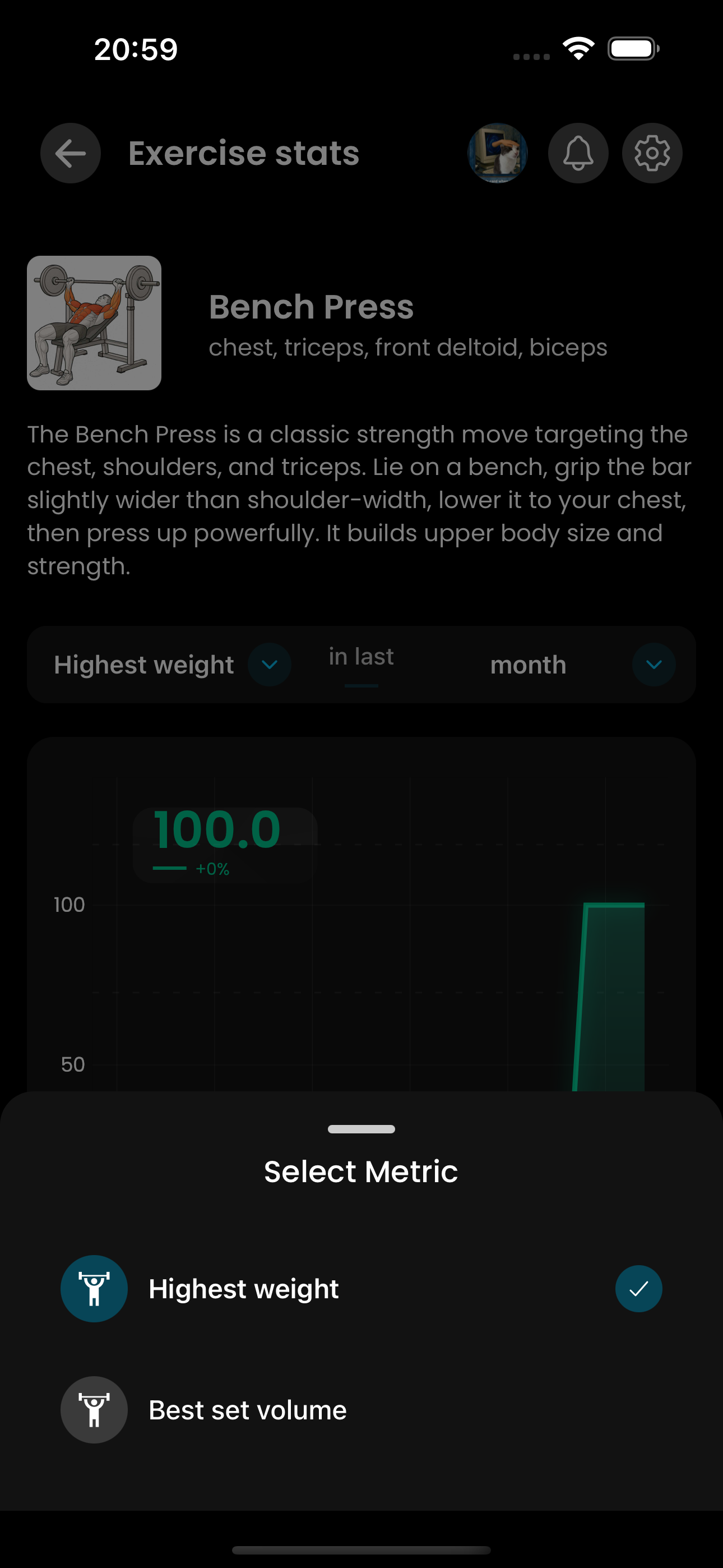
With Gainflow, you see your "Highest Weight" and "Best Set Volume" on one clear chart.
1RM Charts (One Rep Max) – Your Strength Ceiling
Tracking your estimated one-rep max (Estimated 1RM) allows you to monitor strength without having to perform dangerous record-breaking attempts in every workout. Gainflow uses advanced algorithms to calculate how strong you currently are based on your working sets. If the 1RM line goes up, you're building muscle tissue and improving nervous system efficiency.
Want a quick estimate right now? Use our free 1RM Calculator — it averages four proven formulas (Epley, Brzycki, Lombardi, O'Conner) and gives you a full training percentage table for strength, hypertrophy, and endurance ranges.
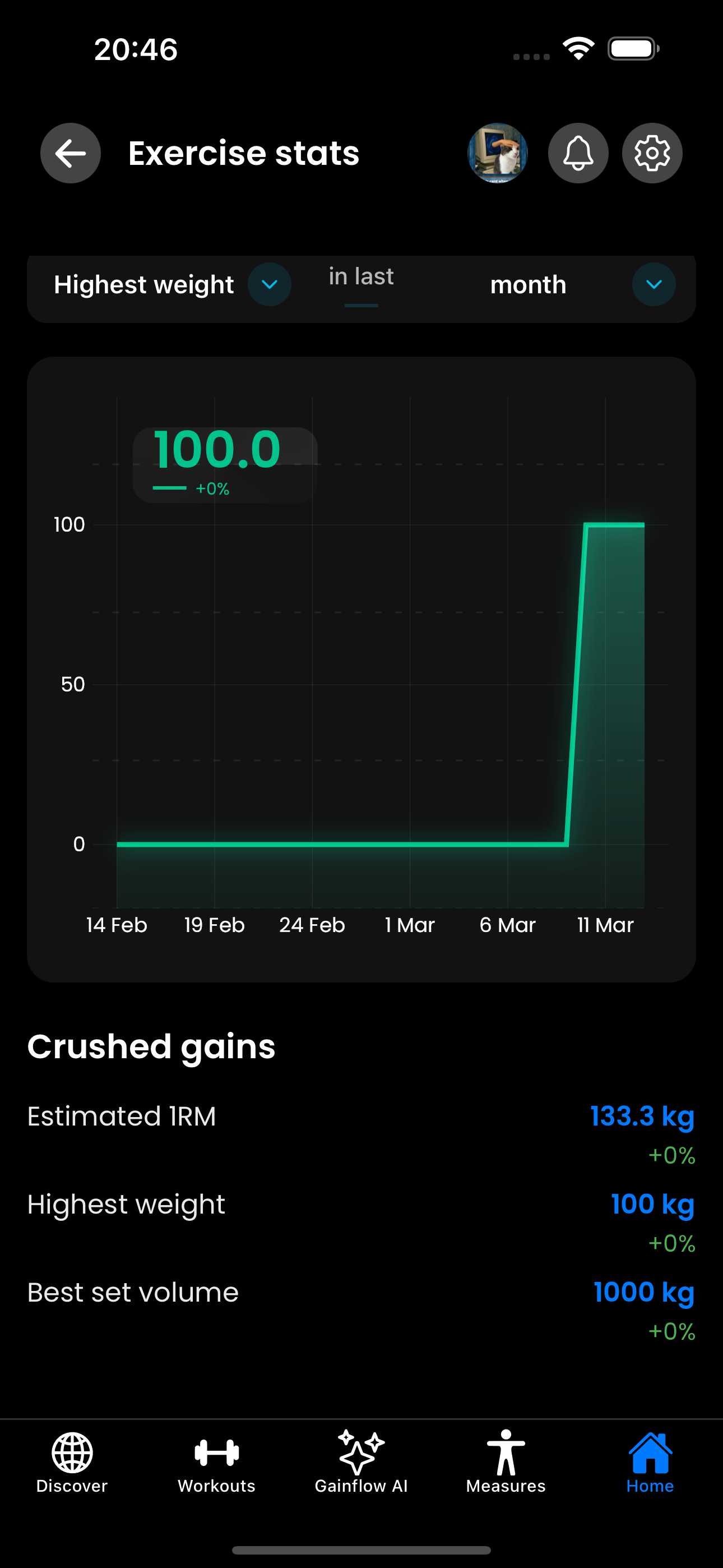
The stats view below the chart allows you to quickly assess progress in estimated 1RM.
Set History: No More Guessing
The biggest advantage of Gainflow is that your training plans remember your last workout. When you enter an exercise, the app automatically shows you what weight and how many reps you did in the last session. Your task is simply to do 1% more. This is a psychological "game changer" – you're not fighting an invisible opponent, you're fighting your version from the previous workout.
Summary: Your Action Plan
Progressive overload is not an option – it's a necessity. Without it, your workouts are merely a form of recreation, not physique transformation. Remember that progression is not linear; there will be weeks where you make a huge leap, and ones where maintaining the result will be a success. The key, however, is to objectively track these changes.
YOUR PLAN FOR THE NEXT WORKOUT
- 1. Download Gainflow: Create your free training journal.
- 2. Plan Your Session: Choose a plan and stick to it for at least 8 weeks.
- 3. Record Everything: Every set, rep, and rest time counts.
- 4. Check the Charts: After each workout, look at volume and 1RM.
- 5. Add More: See what you did last time? Do 1 more rep. Only that much, and yet so much.
Stop Training Blindly
Join thousands of users who build their fitness based on data, not assumptions. Gainflow is a free tool that will guide you through every stage of progressive overload.