Why is Your Squat Progress Stalling? 5 Technical Mistakes
The barbell squat is the undisputed king of exercises for building strength, leg mass, and overall body fitness. Whether your goal is to build massive quads, improve your powerlifting totals, or simply maintain everyday fitness, the squat should be in your training plan.
Unfortunately, it is also an incredibly complex biomechanical movement where technical errors are very common. Poor technique not only drastically slows down progress but also exposes your joints, ligaments, and spine to a huge risk of injury. If your squat results have been stalling for a long time, you feel you're not engaging the right muscle groups, or worse, you feel pain in your knees and lower back after training – you're probably making one of the following mistakes. See what most commonly blocks lifters in the gym and find out how artificial intelligence in the free Gainflow app can help you fix it instantly by analyzing your training video.
5 Main Squat Mistakes That Ruin Your Results
1. Lack of Proper Depth ("Shallow Squat" / "Quarter Squat")
This is absolutely the most common mistake in every gym. Many lifters, driven by the desire to impress others or a misconception of their own strength, shorten the range of motion by putting too much weight on the bar. The so-called shallow squat doesn't fully engage the glutes or the hamstrings (back of the thigh) at all. Instead, massive shearing forces are transferred directly to your knee joints, which must brake the huge weight at the least stable point.
A correct, full squat (so-called "ass to grass" or classic squat) should end when the hip crease is clearly below the top of the patella (knee cap). Going this deep ensures a full stretch of the muscle fibers and provides the maximum stimulus for growth.
⚠️ Mistakes to Avoid
❌ Ego Lifting
Adding weight at the expense of range of motion is the fastest way to injury and lack of real results. Leave your ego in the locker room, take some weight off the bar, and start squatting as deep as your mobility allows.
2. Knees Caving In (Knee Valgus)
When you stand up from the bottom of a squat and suddenly your knees start to violently collapse inward (forming an X-shape), it means there's a serious biomechanical problem. This phenomenon, professionally called "knee valgus," generates enormous stress on the cruciate ligaments (especially the ACL).
Most often, this is a signal of significant weakness in the gluteal muscles (especially the gluteus medius), poor activation of the hip external rotators, or drastic deficiencies in neuromuscular coordination. Your body, trying to lift the weight at all costs, searches for strength by changing the movement mechanics to a very incorrect one. Fixing this error requires work on strength and mobility, as well as consciously "screwing" your feet into the floor and intentionally pushing your knees outward throughout the entire movement.
3. Heels Lifting Off the Floor in the Bottom Phase
A correct, strong squat always starts with the feet. Poor distribution of the body's center of gravity and a common lack of mobility in the ankle joint (e.g., tight calves and Achilles tendon) often cause the lifter to lift their heels off the ground and transfer all the weight to the front part of the foot (toes) while going down.
This leads to a complete shift of the center of gravity forward, heavily loading the knees and forcing the back into unnatural, compensatory work. Body weight in the squat should always be evenly distributed over the entire surface of the foot, resting on three key points: the heel, the base of the big toe, and the base of the little toe (so-called tripod foot support). Lifting shoes with a raised heel can help, but the foundation should be working on ankle dorsiflexion.
4. Rounding the Back and Lack of Tight Core Tension
While squatting, your torso must act like a steel cylinder. Keeping a loose belly while going down with a heavy barbell on your back is a recipe for disaster for your lumbar spine.
Always remember: before starting the downward movement, you must take a deep breath, directing the air straight to your stomach and diaphragm (the so-called Valsalva maneuver), and then tighten your core muscles hard, as if preparing to take a strong punch to the gut. This intra-abdominal pressure will stabilize your spine. Lack of proper central stabilization will cause you to lean forward uncontrollably under the weight, and your back will start to round, which exerts giant pressure on the discs and risks a hernia.
5. "Butt Wink" (Pelvic Tucking at the Very Bottom)
This is an extremely popular phenomenon in the training world where, at the lowest point of the squat, the pelvis suddenly rotates downward (tucks under you), causing a visible rounding of the lower back. While a very subtle and controlled "butt wink" at maximum depth may simply result from natural hip anatomy and femur structure, clear, strong rounding of the back with weight is a red flag.
Regular butt wink under load leads to micro-traumas of the intervertebral discs. It usually results from insufficient posterior chain mobility, poor starting posture, or forcing depth that exceeds your current flexibility and motor control.
How Does AI in the Free Gainflow App Analyze Your Squat?
In theory, all these rules sound very sensible. The problem is that it's extremely difficult to see your own mistakes, especially during a heavy, demanding set that requires maximum focus, when you feel muscle burn and fatigue. You might think you're going deep enough and keeping a straight back, while a recording would show a completely different truth.
That's why we've equipped our smart, free Gainflow app with revolutionary video analysis, powered by powerful artificial intelligence (AI). Simply lean your phone against a water bottle, record your set from the side or at a slight angle, and advanced algorithms will do the rest, instantly identifying even the smallest deviations from biomechanical norms.
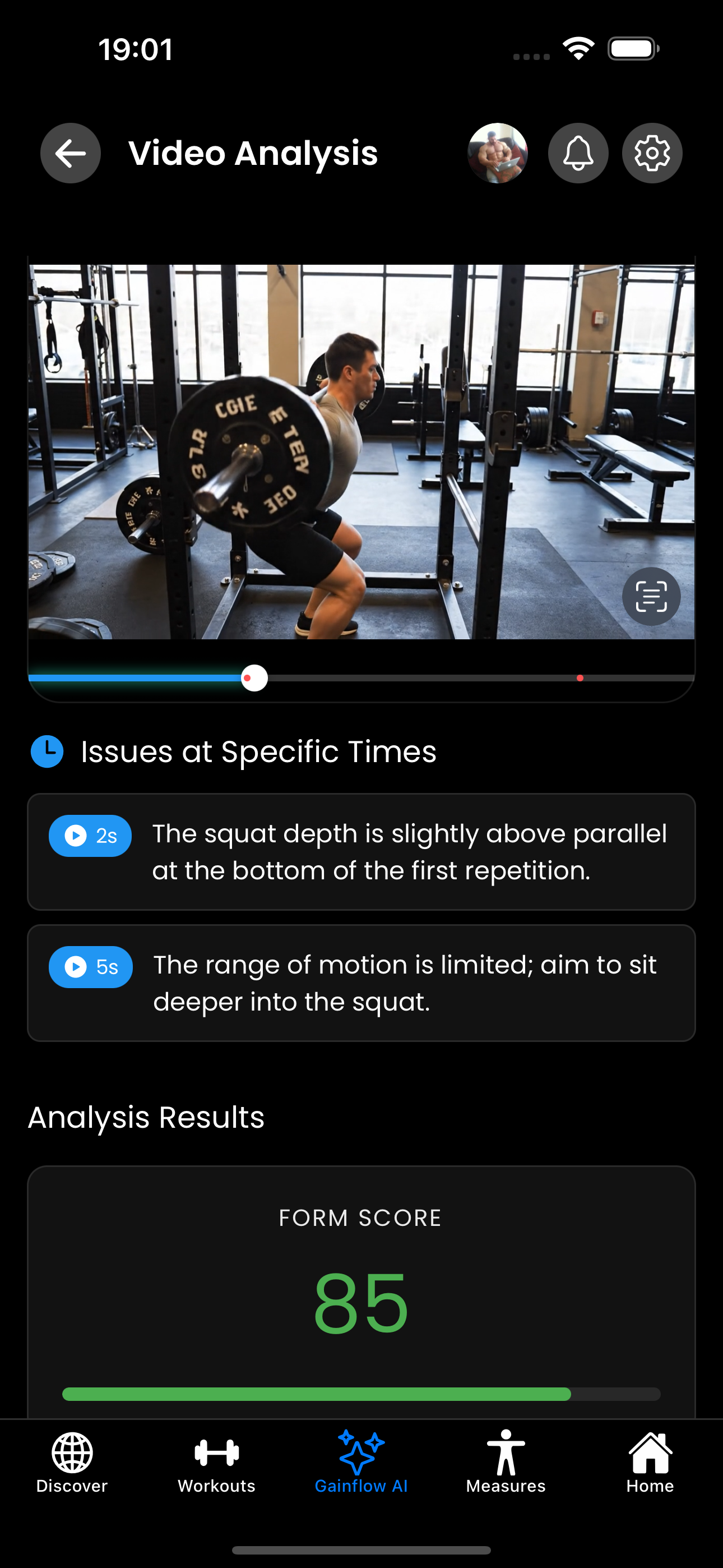
Gainflow AI checks your technique for the errors mentioned above in seconds.
How exactly does it work? The Gainflow system automatically and with great precision processes your movement, checking it literally frame by frame. If, during the concentric phase (standing up), your knees move dangerously close to each other, undergoing the "knee valgus" effect, Gainflow will immediately identify it. No more wondering if that was a proper squat below parallel – the algorithm will precisely calculate the joint angles, ensuring you didn't waste a rep on a shallow movement.
Personal Trainer in Your Pocket
Hiring a good trainer to correct your technique at every session costs thousands of dollars a month. Gainflow analyzes technique completely for free, allowing for systematic, daily correction of errors on every working set, without wasting time.
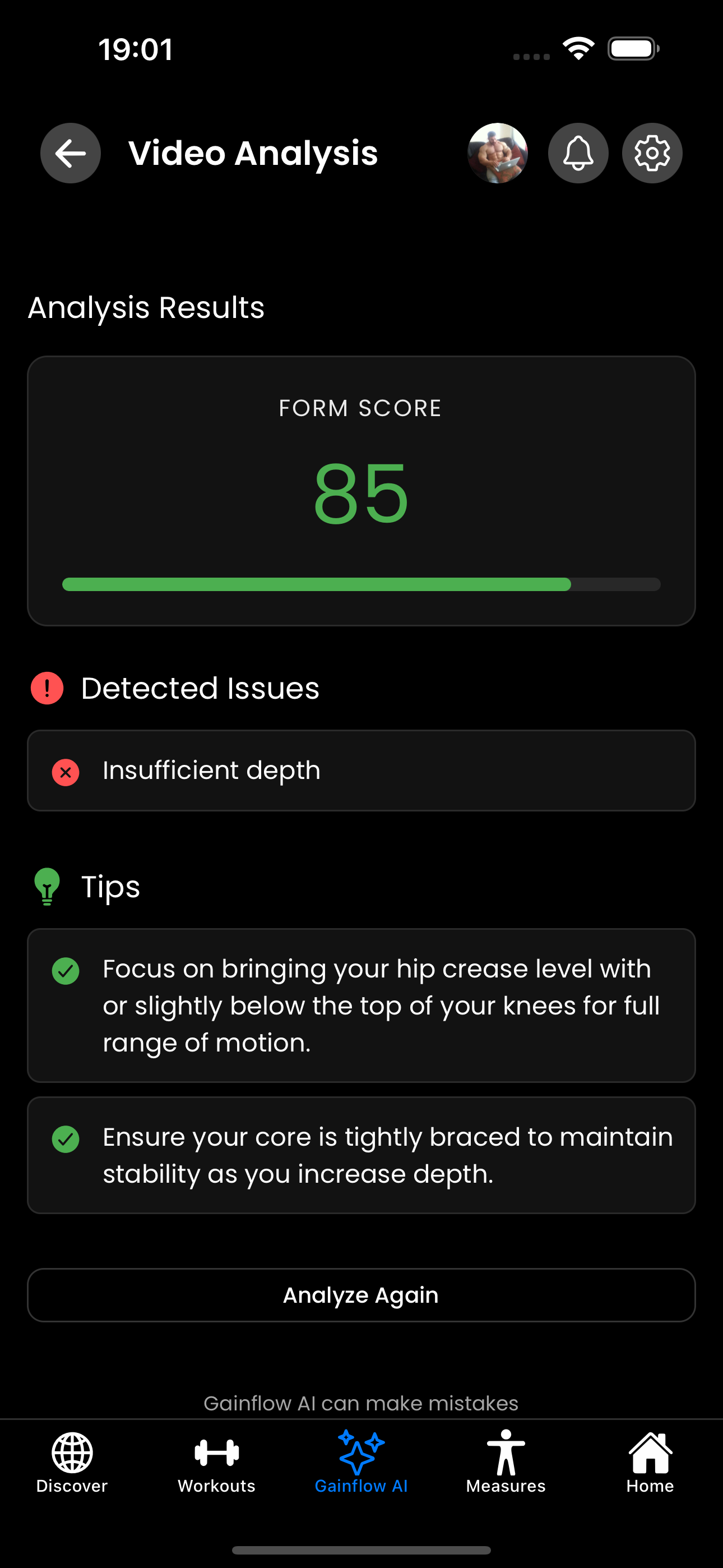
After processing the video, you'll see a precise report indicating the exact time the problem occurred and comprehensive tips for improving posture.
When the analysis is complete, Gainflow will generate a clear, readable error report with precise timestamps. This way, you know right away that in the third rep, at the 14th second of the recording, you started to lift your heels and shift the weight toward your toes. But that's not all – AI will also provide you with exhaustive, tailored instructional tips, posture modification suggestions, and corrective exercises that will help you get rid of bad movement habits immediately in your next workout. This way, you lift more, and your joints stay safe.
✨ Why Analyze Your Squat in Gainflow?
🛡️ Injury Prevention
Maximum Safety
Protect your ankles, knees, and lower back by learning to lift the way nature intended.
Objective Control
Get an honest, mathematical picture of your technique without kidding yourself.
📈 Impressive Progress
Unlock Strength
Clean technique means better power transfer from legs to bar – you'll feel it when hitting PRs.
Habit Building
Constant feedback at every workout solidifies perfect neuromuscular patterns.
Analyze Your Squat with AI
Download the free Gainflow app and start analyzing your workout recordings using powerful artificial intelligence. Get rid of bad habits, protect your joints from painful injuries, and increase your strength results using tips straight from top powerlifting experts.